IDAP and NBAT vehicles, drones, field infrastructure, and protective equipment deployed across Altis.
NBAT operates a mixed fleet of cargo vans, Offroads, SUVs, Zamaks, and HEMTT transport trucks across Altis. Since REIMAGINE, every run location shifts on restart — so the fleet adapts every time. All vehicles registered with APC and display IDAP markings. Armed variants stay outside the Green Zone. Everything else goes everywhere.
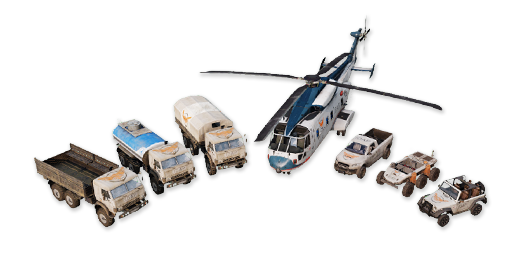
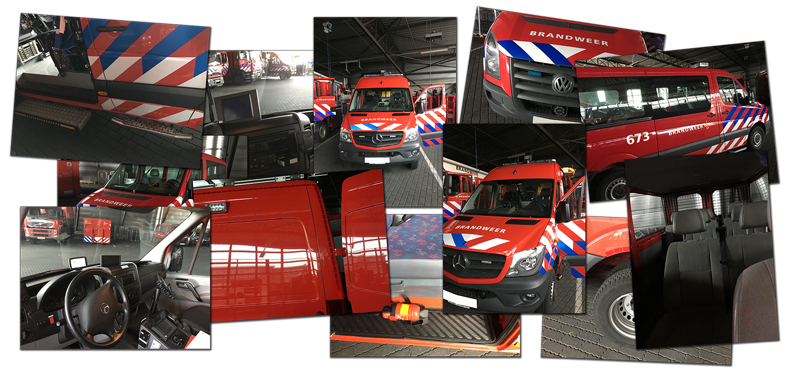
Primary logistics vehicle. Available in cargo, personnel, and ambulance configurations with over twenty liveries. Used for medical supply runs to Kavala Hospital, postal relocation to Neri Depot, and financial courier operations between depositories. Capable of carrying large quantities of processed goods.
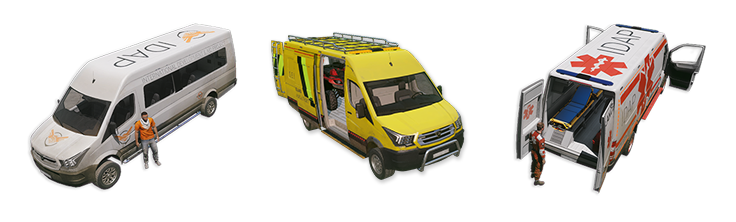
Cargo variant for bulk supply transport. Ambulance variant coordinated with NHS for medical evacuation on the Pyrgos-Kavala corridor. Personnel transport for moving NBAT operators between staging areas. All variants support three passenger positions and secure cargo storage.
The workhorse of every NBAT security detail. Fast, reliable, cheap enough to replace, effective enough to rely on. Armed HMG variants available for operations outside Green Zone — because inside Kavala, armed vehicles are prohibited. Outside Kavala, they're encouraged.
Personnel transport and rapid response. Leadership movement, scouting the new dynamic run locations each restart, and getting somewhere fast when full convoy deployment is overkill. The vehicle you drive when you need to be first, not strongest.
The serious haulers. HEMTT Box is the largest cargo vehicle on Altis — the kind of truck that makes a Tier 6 run worth getting out of bed for. Zamaks handle the mid-range loads. NBAT runs 3-5 truck convoys depending on the route. Some of these are craftable at Vehicle Factories — because when you control the production chain, you don't buy trucks. You build them.
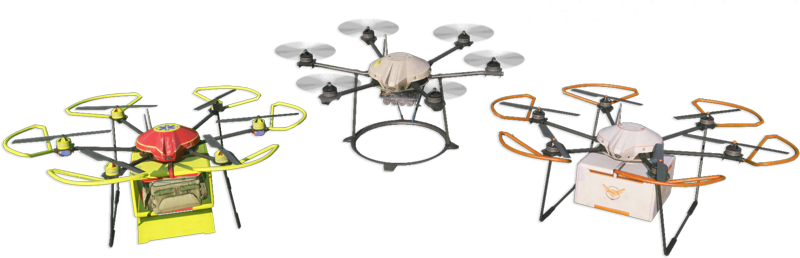
The Pelican is a six-propeller utility drone system deployed in three configurations: cargo delivery, medical supply drop, and demining operations.
The demining variant carries a mine detection ring capable of identifying explosive ordnance up to 50 metres away, with four onboard charges for controlled detonation. Used extensively in the Oreokastro EOD programme.
The cargo variant ("Pelican") is used for emergency resupply drops to remote NBAT positions where road access is contested or blocked. Medical variant coordinates with NHS for aerial supply to field clinics.
Note: Helicopter operations into Kavala Green Zone are prohibited — except for NHS medics, who apparently earned the privilege by passing flight school. Doctors get M-900s, Surgeons get the bigger birds. Meanwhile, APC's NPAS division owns the skies island-wide with Hummingbirds, Hellcats, and Hurons. IDAP doesn't compete in the air. We dominate on the ground.
Left to right: cargo/supply variant, medical delivery variant, demining variant with detection ring. All variants use the same six-propeller airframe with blade protectors for operational safety.
IDAP vans and drones deployed together at forward staging areas. Vans transport bulk supplies while drones provide rapid last-mile delivery to locations inaccessible by road.
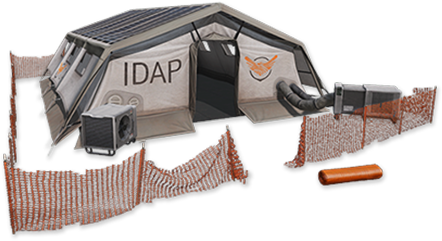
Rapid-deployment shelter tents for displaced civilians and field medical stations. Multiple configurations including open, closed, and medical variants.
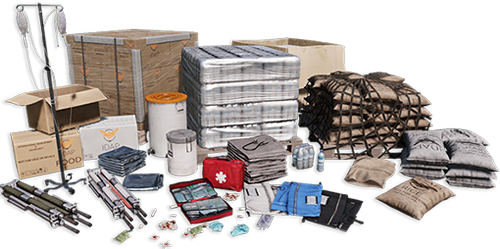
Cardboard supply boxes, water bottle pallets, thermal blankets, body bags, and emergency rations. Distributed from Kavala Hospital and Neri Depot.
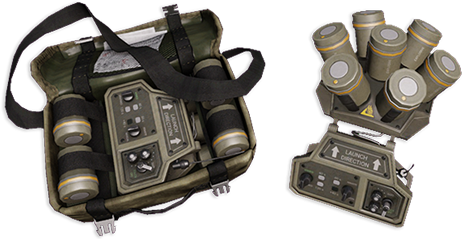
Portable mine clearance system. Backpack-deployed with 2 mini-mines across 7 tubes covering 25 square metres. Used in the Oreokastro clearance programme.
All NBAT and IDAP field personnel must carry minimum required equipment during operations.
Personnel not properly equipped will not be permitted to participate in NBAT operations. Being properly equipped is mandatory — no exceptions. For context: NBAT's minimum equipment standard (Level 3 armour + suitable firearm) exceeds the total equipment carried by the average HATO officer, whose standard loadout appears to consist of a traffic cone and an overwhelming sense of self-importance.
NBAT's equipment and deployment policy is built on one principle: never be outgunned, never be outnumbered, never be unprepared.
NBAT deploys a minimum of 4-6 armed, Level 3+ armoured operators for every convoy escort and interception — regardless of the perceived threat level. A solo runner in a hatchback receives the same tactical response as a rival gang convoy. This is not overkill — it is risk elimination. The 3% of targets who attempted to fight back in Q1 2026 serve as evidence that our force posture is appropriate, not excessive.
The average solo runner on Altis carries: one firearm (maybe), basic armour (sometimes), and hope (always). The average NBAT interception team carries: 4-6 firearms, Level 3+ armour on every operator, multiple vehicles, radio coordination, pre-planned positioning, and the knowledge that they have done this 247 times before. The equipment differential is not a flex — it is the reason NBAT's success rate is 100% and the reason our convoy loss rate is 0%.